
Regulatory Insights
Cosmetic label claims in Sri Lanka: what the NMRA accepts, restricts and refuses
What the National Medicines Regulatory Authority (NMRA) publishes on cosmetic label claims in Sri Lanka: claims refused, claims accepted with evidence, the evidence required and the advertising rules.
A claim on a cosmetic label is a regulatory statement, not only a marketing one. In Sri Lanka the National Medicines Regulatory Authority (NMRA) has published which claims it refuses, which it accepts only with evidence, and what that evidence must be. A label that was acceptable in another market can therefore hold up a registration here.
This article brings together what the NMRA publishes on cosmetic claims: the decisions of its Cosmetic Evaluation Subcommittee, the registration guidance on evidence, and the rules on advertising. The wording follows the NMRA's published text closely. The NMRA states that the subcommittee's decisions are subject to revision or amendment from time to time.
Start with what a cosmetic is
The NMRA's Cosmetics page defines a cosmetic as a substance or preparation used on the external parts of the human body, or the teeth and the mucous membranes of the oral cavity, for the exclusive or main purpose of cleaning, perfuming or protecting them, keeping them in good condition, changing or modifying their appearance, or correcting body odours.
A claim that goes beyond those purposes raises a classification question before it raises a labelling one. The subcommittee's decision on the word "Treatment", below, reflects the same line.
Claims the NMRA does not accept
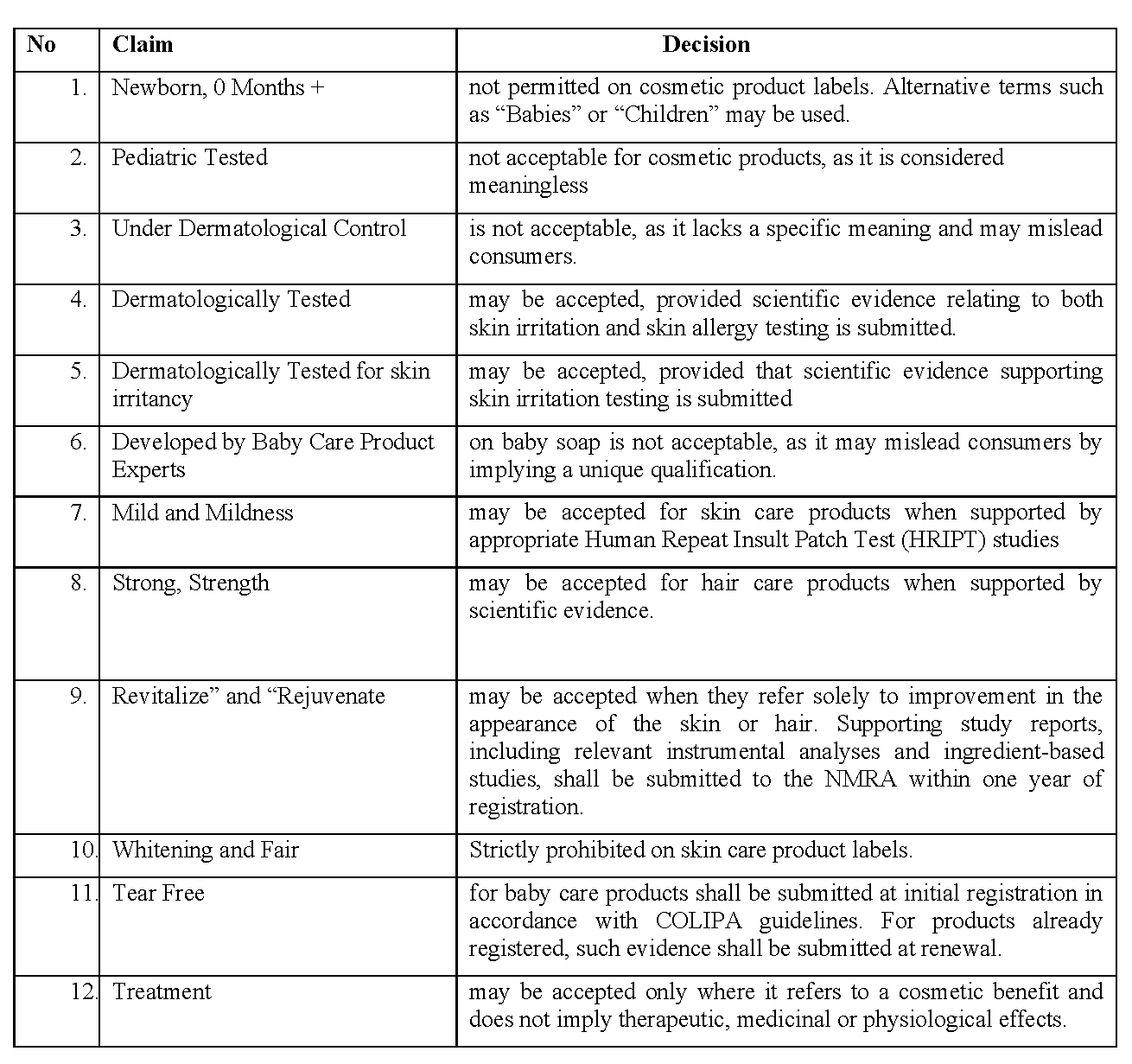
- "Newborn" and "0 Months +". Not permitted on cosmetic product labels. Alternative terms such as "Babies" or "Children" may be used.
- "Pediatric Tested". Not acceptable for cosmetic products, as it is considered meaningless.
- "Under Dermatological Control". Not acceptable, as it lacks a specific meaning and may mislead consumers.
- "Developed by Baby Care Product Experts". Not acceptable on baby soap, as it may mislead consumers by implying a unique qualification.
- "Whitening" and "Fair". Strictly prohibited on skin care product labels.
- "Contains glutathione". Products containing glutathione below 2% (w/w) may be registered as cosmetics, but claims such as "Contains glutathione" and "whitening", or any similar meaning, are not permitted.
Claims accepted only with evidence or within limits
- "Dermatologically Tested". May be accepted, provided scientific evidence relating to both skin irritation and skin allergy testing is submitted.
- "Dermatologically Tested for skin irritancy". May be accepted, provided scientific evidence supporting skin irritation testing is submitted.
- "Mild" and "Mildness". May be accepted for skin care products when supported by appropriate Human Repeat Insult Patch Test (HRIPT) studies.
- "Strong" and "Strength". May be accepted for hair care products when supported by scientific evidence.
- "Revitalize" and "Rejuvenate". May be accepted when they refer solely to improvement in the appearance of the skin or hair. Supporting study reports, including relevant instrumental analyses and ingredient-based studies, shall be submitted to the NMRA within one year of registration.
- "Tear Free". For baby care products, evidence shall be submitted at initial registration in accordance with COLIPA guidelines. For products already registered, the evidence shall be submitted at renewal.
- "Treatment". May be accepted only where it refers to a cosmetic benefit and does not imply therapeutic, medicinal or physiological effects.
What the evidence must be
Three published requirements apply to the evidence itself:
- Every label claim needs support. The registration guidance states that the product dossier should contain all supportive scientific evidence or clinical studies for label claims, for both local and imported products. It names "dermatologically tested for skin irritancy and allergy", "ophthalmologically tested", "revitalize", "rejuvenate" and SPF value as examples, and says the requirement is not limited to those.
- Finished product, not ingredients alone. Scientific evidence submitted in support of a product claim shall relate to the finished product and shall not be limited to individual ingredients.
- Readable English. Scientific evidence shall be submitted in readable English. Documents other than the required supporting documents shall not be accepted for cosmetic product registration.
SPF and sunscreens
SPF value is one of the claims the NMRA names as needing evidence. Separately, the Medicines Evaluation Committee decided at its 117th meeting on 25 August 2026 that sunscreen products with an SPF above 30 shall be considered and regulated as cosmetic products and shall not require registration as medicines. The published decision does not state how sunscreens with an SPF of 30 or below are to be treated, so the position for a particular sunscreen should be confirmed with the NMRA. Our article Sunscreens in Sri Lanka covers this in more detail.
Herbal, "Ayurvedic" and therapeutic claims
Products containing herbal ingredients and making therapeutic, medicinal or "Ayurvedic" claims shall be referred to the Department of Ayurveda. Products containing herbal ingredients listed in the EU CosIng database with recognised cosmetic functions may be considered by the Cosmetic Regulatory Division where no Ayurvedic, therapeutic or medicinal claims are made.
In practice the wording of the claim, and not only the ingredient, decides which body considers the product.
Statements a label must carry
Some decisions require wording rather than restrict it:
- An appropriate warning for pregnant women shall be included on the labels of all cosmetic products containing retinol.
- Cosmetic products intended for hotel use shall be clearly labelled "For Hotel Use Only".
- For cosmetic products marketed locally, directions for use shall be provided in English, Sinhala and Tamil, on the primary packaging, the secondary packaging or an insert leaflet. For products intended for export markets, directions for use may be provided in English only.
Advertising the same claims
A claim accepted on a label is not automatically cleared for advertising. The NMRA's Advertising Committee regulates printed and electronic advertisements for cosmetics, and the NMRA publishes two general rules:
- Any person who wishes to advertise or promote a cosmetic should get the prior written approval of the Authority.
- Cosmetics should not be advertised or promoted to the general public for the treatment, prevention or cure of any of the prescribed diseases, disorders or abnormal physical states.
What RAQ suggests checking
The points below are RAQ's suggestions. They are not NMRA requirements.
- List every claim on the label, carton, leaflet and any sticker, including claims carried over from an overseas pack and claims in the product name.
- Mark each claim as not accepted, accepted with evidence, or not addressed in the published decisions. Claims the NMRA has not addressed still need evidence under the registration guidance.
- For each claim that needs evidence, confirm that a study exists, that it was carried out on the finished product, and that the report is in English.
- Check words that describe the consumer as well as the product, such as age terms on baby products.
- For products already registered, note the claims for which evidence is expected at renewal or within one year of registration.
- Review advertising and social media wording separately from the label.
Our Cosmetics page explains the registration routes and the documents commonly reviewed.
Official references
- NMRA Cosmetics
- https://cdn.prod.website-files.com/6682284ea1b9313c63cb86c6/6ad5af38189d8d3ce34b9d0d_CESC_Public_Notice_2026_Page_1.png
- https://cdn.prod.website-files.com/666d0695ca3ba7fa496a5068/6aeacc854c41f5c2102dc9b6_Policy%20decisions%20114-118-1.pdf
Read the Regulatory Information Disclaimer.